


Maya Ruins in the Yucatán: A Road Trip Through Ancient Civilization
The Yucatán Peninsula in Mexico is famous for two spectacular highlights: its clear-water cenotes and its awe-inspiring Maya ruins. I’ve already written a dedicated post about cenotes, let me tell you a bit more about the fascinating world of Maya ruins—ancient archaeological treasures hidden deep in the lush Mexican jungle. In this guide, I’ll share everything you need to know to visit these incredible historical sites.
During our Yucatan road trip, we visited some of the most iconic and lesser-known Maya ruins—from the world-renowned Chichen Itza, to the serene Ek Balam, and the remote, jungle-shrouded Calakmul. Each site has its own unique spirit and charm, making it nearly impossible to choose a favorite.
If you’re planning a road trip through the Yucátan Peninsula, seeing these Maya ruins is an absolute must. You can also check my guide on practical tips for driving in Mexico to help you make the most of your adventure.
Let’s dive into the heart of one of the most captivating ancient cultures in the world!
The Maya: a Super Fast History Lesson
I don’t know about you, but personally, I used to get all mixed up when it came to pre-Columbian civilizations. Before actually traveling, I couldn’t clearly tell one from another—they were just a blur of pyramids and ancient names. Luckily, traveling helped shed light on the differences between these fascinating cultures
Soon, I’ll tell you all about our honeymoon in Perú and the incredible world of the Incas (who, by the way, were the only major pre-Columbian civilization in South America). But right now, it’s time to focus on the Maya civilization.
To be precise, the Maya weren’t an empire like the Incas or Aztecs. Instead, they were a collection of independent city-states, each with its own ruler—sometimes allies, sometimes at war.
Chronologically, the Classic Period (250–900 CE) was the height of Maya civilization, with major cities like Tikal and Calakmul thriving deep in the jungle. This era gave us the Maya writing system, sophisticated calendars, and achievements in astronomy and mathematics.
After 900 CE, many of the great southern cities were abandoned, and power shifted north. This is known as the Postclassic Period (900–1500 CE), with new centers like Chichén Itzá and Uxmal, each with its own unique architecture and traditions.
And here’s the most important part: the Maya didn’t disappear. Despite centuries of colonization and change, millions of Maya people still live across Mesoamerica today, speaking Maya languages and preserving their vibrant culture.
Visiting the ruins is just one way to know the Maya civilization!
Ek-Balam

Ek Balam—meaning “Black Jaguar” in the Maya language—was the very first archaeological site we visited during our Yucatán Peninsula road trip. Located just north of Valladolid, Ek Balam is smaller and less crowded than more famous ruins like Chichen Itza, but it has a charm all its own. The ruins here are partly hidden by dense vegetation, adding a mystical vibe, and when we visited in January 2025, climbing the pyramids was still allowed. The site is also home to many iguanas, and the highest structures are impressively well preserved.
At the site’s exit, there are a few small artisanal stalls. True to the name of the place, we picked up a little jaguar-head whistle that mimics the animal’s call when you blow into it.
While there’s a beautiful cenote nearby—Cenote X’Canche’—we didn’t get the chance to visit it as we had plans to continue on to Río Lagartos. But if you have time, it’s definitely worth a stop!


Practical Information for Visiting Ek-Balam
Make sure you input the correct location on Google Maps (see table below), as there are similarly named places that could take you elsewhere. Just before the entrance, there’s a registration checkpoint where they’ll ask how many people are in your group and your country of origin. Shortly after, you’ll come to a booth where you pay for parking, which is conveniently located right by the entrance.
The ticket office is modest and uncrowded, and there’s no need to book in advance since Ek-Balam sees fewer tourists. You can also hire a guide on site for a deeper dive into the history, but we chose to skip it this time as we had tours planned at other archaeological sites. Instead, we focused on letting the kids roam and explore—just as they love to do.
| Cost | Location | Website |
|---|---|---|
| parking : 100 MXN ticket adult: 500 MXN children<4: free guides: 600/800 MXN | https://maps.app.goo.gl/8A8hSNkNzcCJbapy8 | https://www.inah.gob.mx/zonas/21-zona-arqueologica-ek-balam |
Chichén Itzá

Who hasn’t heard of Chichén Itzá? Maybe the name doesn’t immediately ring a bell, but I’m sure you’ve seen a photo of its iconic pyramid—El Castillo—which lights up in a fascinating way during the equinox. Every year, on these special dates, the sunlight hits the pyramid in just the right way to create a shadowy illusion of a feathered serpent—Kukulkan—descending down the staircase. This animal in Maya culture is the symbol of fertility. Moreover, If you clap your hands in just the right spot in front of El Castillo, the echo bounces back mimicking the call of the sacred Maya bird: the quetzal.
Located just 40 minutes west of Valladolid, Chichén Itzá is arguably the most famous Maya ruins in Mexico—and with its global fame come the crowds. Fortunately, we booked a private guide through Civitatis, which turned out to be a great choice.
The archaeological zone is huge. While El Castillo is the star attraction, the site features many other fascinating structures, including the Temple of the Warriors and the impressive Juego de Pelota—the ancient Maya ballcourt, where the game was played using balls made from caucho (rubber).
The area around the main pyramid is filled with artisans (some more authentic than others) who will try to sell you everything imaginable. Of course, we couldn’t leave without a souvenir. We fell into the artisan trap (willingly!) and asked our guide to help us find something truly handmade. He led us to a small stall where we found beautifully crafted wooden magnets and a teponaztli—a traditional wooden slit-drum shaped like an owl. I couldn’t resist. Leo probably thought I was a bit crazy, but I managed to convince him to get it. No regrets!


Practical Information for Visiting Chichén Itzá
Aside from booking your guided tour in advance (e.g. on Civitatis), there are a few other things to keep in mind. First, parking can be tricky. Expect about 20 minutes of traffic as you approach the site, especially during peak hours. Once you pass the roundabout before the entrance, just choose one of the nearby parking areas. The price difference between lots is minimal, and chances are you won’t find a spot right in front of the entrance anyway.
Inside the archaeological zone, there’s very little shade around the main pyramid, so bring plenty of water—especially if you’re visiting Chichén Itzá with kids. You’re not allowed to climb any of the structures here (unlike other Maya sites), so please respect the rules.
All in all, visiting Chichén Itzá was an impressive experience, but we suffered a lot the crowds and the tourist-like treatment: shops allover and our guide, while informative, felt a bit rushed—like he was late for his next tour. I probably would not visit for a second time, unlike other ruins.
You can check my table below with costs and practical links.
| Cost | Location | Website |
|---|---|---|
| parking : 80 MXN ticket adult:648 MXN children<3: free children (3-12): 100 MXN guided tour (2 pax): 50 EUR | https://maps.app.goo.gl/J5LJxM4HUmDNEFnYA | https://www.chichenitza.com/tickets |
Uxmal

Our third stop on our exploration of Maya ruins in the Yucatán Peninsula was the incredible site of Uxmal, located south of Mérida. The name Uxmal is thought to mean “thrice built” or “built three times,” possibly referring to the multiple layers of construction found in its impressive structures.
What makes Uxmal particularly unique is its main pyramid, which stands out for its unusual oval shape (rather than the typical square base seen at other Maya pyramids). This structure is called the Pyramid of the Magician (also known as the Pyramid of the Dwarf), and local legend says it was built in a single night.
We booked a tour with the same company we used at Chichén Itzá, and this time, our guide was patient and thoughtful—especially with the kids. He gave us plenty of time to explore the site at our own pace and was happy to answer all of our curious questions.
What sets Uxmal apart from other Maya ruins is how well the decorative carvings are preserved. You can spot incredible sculptures of elephants, turtles, and snakes adorning the buildings. The city is dedicated to Chaac, the Maya god of rain, whose face appears all over the site: a jaguar-like mouth, upturned nose, rounded eyes, and squared ears.


Just like at Chichén Itzá, if you clap your hands in front of the Pyramid of the Magician, you’ll hear the echo produce a bird-like sound—another magical acoustic detail of Maya architecture. Uxmal also includes fascinating ruins of what is believed to be a school or residence, dubbed the “Quadrangle of the Nuns” (Cuadrángulo de las Monjas) by a Spanish explorer who thought the niches resembled those in a convent.
Practical Information for Visiting Uxmal
Visiting Uxmal is much easier than Chichén Itzá in terms of logistics and crowds. There’s a convenient parking lot right outside the site, and we didn’t experience any traffic or waiting. We paid 1,250 MXN for our guide, booked in advance. However, on-site guides are available for significantly less, and unlike Chichén Itzá, it seems totally manageable to arrange a guide on the spot.
Below, you’ll find a breakdown of the entrance costs for different age groups and helpful links to plan your visit.
| Cost | Location | Website |
|---|---|---|
| parking : 100 MXN ticket adult:561 MXN children<4: free guides: 800 MXN | https://maps.app.goo.gl/f3fxXJoFKuBcNLLw5 | https://inah.gob.mx/zonas/110-zona-arqueologica-de-uxmal |
Calakmul
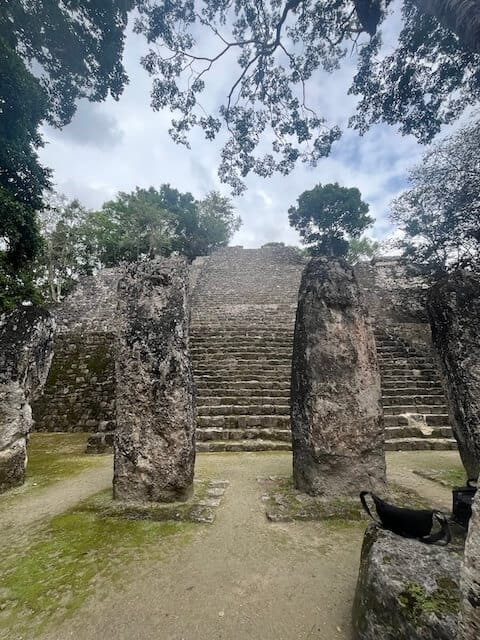
Impossible to hide: the charm of Calakmul, the lost Maya city buried deep in the jungle, is truly unmatched. When we visited, it still felt like a forgotten world—but probably not for long. The new Maya Train project is already in progress and will soon connect directly to Calakmul. While it may make access easier, I fear it could also bring in less respectful tourism. That said, our visit to Calakmul was one of the most unforgettable stops on our Yucatán road trip.
Located near the border with Guatemala, Calakmul is the most remote of all the major Maya archaeological sites. Unlike the later and more polished cities like Chichén Itzá, Calakmul dates back to an earlier era of Maya civilization.
This is the kind of place where you feel the power of nature reclaiming human history. The towering pyramids—on which climbing is still allowed—rise from dense, tropical forest. The vegetation swallows the ruins, and the atmosphere is absolutely surreal. We even saw wild spider monkeys swinging through the trees, especially active at dawn, making the experience feel like a true jungle expedition.
I actually wrote a full, detailed post about Calakmul and the surrounding area, including where to stay, what to do aside from ruins sightseeing, and why it’s worth the effort—so definitely check that out if you’re planning to visit.
Many travelers skip Calakmul, assuming it’s just another Maya site. But that’s exactly why it’s so special. It remains untouched by mass tourism and still holds the mystery of a lost world. One day I will certainly go back!


Practical Information for Visiting Calakmul
Getting to Calakmul is an adventure in itself. It lies roughly 4 hours southeast of San Francisco de Campeche and about 2 hours west of Bacalar. The road from San Francisco de Campeche is in very poor condition, while the route from Bacalar is slightly better. You can read about our full experience in this post.
The nearest town is Xpujil, which is still a 2 hour drive from the actual entrance to the ruins. The visitor area is newly built, with detailed information panels—although with small kids, we didn’t get much time to read them!
We visited as part of a guided tour, so I can’t comment on parking costs. However, during our visit, the guide didn’t share much historical detail, and I didn’t notice any guides available on-site—but that may have changed since.
| Cost | Location | Website |
|---|---|---|
| Shared Tour with Kaan Expeditions including lunch (1person):2200 MXN | https://maps.app.goo.gl/22Ek2ipxjqUb3wwY7 | https://www.visitcalakmul.com |
Tulum

Our last Maya ruin stop was in the coastal town of Tulum, just one hour south of Playa del Carmen. Tulum it is unique among all the other Maya ruins because of its location on the seashore. The site it is also much smaller than others and there’s no shade. We were lucky enough to see it on a sunny day where Tulum explodes with its beauty.
The ruins perched on the cliff are incredible and absolutely worth a visit. The structures here are different from those at other sites, reflecting the strong connection this fortified city once had with maritime commerce. Interestingly, the Maya didn’t have a compass or sextant—so the coast was their only point of reference. And no sails either—everything was done with paddles!
While visiting the site you can also notice a small charming beach, now closed to visitors and used as a safe haven for baby turtles.
With your park entrance ticket though, you’re allowed to access another beach close to the ruins. However, the sea was a bit rough that day, and since it was already lunchtime, we decided to skip it. If you make it down there, let me know how it is!


Practical Information for Visiting Tulum
In Tulum, parking is simple and convenient. You drive up to the ticket office and park your car quite close to the entrance (here the exact location). First, you’ll need to buy your initial entrance ticket at the ticket booth. Then, after walking a bit further, you’ll reach a second checkpoint where you need to purchase a second ticket. After that, you’re good to go!
To reach the actual entrance of the Tulum ruins, you’ll walk a few hundred meters. While they do offer electric shuttle buses, the distance is so short that walking is often the better option. Just before entering the archaeological site, you’ll find clean restrooms and a small bookstore where you can pick up guides or souvenirs.
Be aware that the last entry to the ruins is at 15:30.
| Cost | Location | Website |
|---|---|---|
| ticket adult: 515 MXN children <13: free shared guided tour with GetYourGuide(2 pax):50 EUR | https://maps.app.goo.gl/KGjzCnes5Yy2fChx9 | None of relevance |
Visiting Maya Ruins With Kids

At first, I had serious doubts about visiting Maya ruins with very young children—ours were just 2 and 3 years old at the time. Our last cultural stop—Versailles—was a total disaster. But this time, the experience couldn’t have been more different. Surrounded by nature, the archaeological sites felt like giant open-air playgrounds. And the moment the kids spotted the iguanas—excuse me, dragons—it turned into an epic adventure of chasing and spotting these mini dinosaurs. Total win!
That said, exploring Maya archaeological sites with kids comes with a few challenges. Below is a list of practical tips to help make your visit a success:

? 1. Prepare for the Heat
Some sites, like Chichén Itzá, offer little to no shade. Combine that with Yucatán’s intense sun, and you’ve got a recipe for toddler meltdowns. Bring light, breathable clothing, high SPF sunscreen, hats, and plenty of water—especially for the little ones.
? 2. Avoid Rigid Group Tours
Group tours often follow tight schedules with long hours in the van, limited breaks, and rushed visits—not ideal for young kids. If your budget allows, I highly recommend booking a private tour. In Mexico, they’re surprisingly affordable and way more flexible.
? 3. Be Cautious with Nature
You’re still in the jungle, and the flora and fauna can be unfamiliar—or even dangerous. In Calakmul, for example, we were on high alert as the place is home to a deadly red snake. Always keep an eye on what your kids are touching or playing with.
?♀️ 4. Climbing Can Be Risky
Some sites allow you to climb the pyramids, but these stairs are steep and uneven. If your child is prone to sudden moves or not quite steady on their feet, it might be safer to admire the view from below. A fall could mean a trip to the hospital—or worse.
? 5. Keep Them Engaged
The key is turning the visit into a game. For us, iguana hunting (not literally, don’t worry!) was the perfect activity. It kept them curious, active, and excited to explore.
Conclusion: Which Maya Site To Choose?
If I had to give advice, I’d personally avoid Chichén Itzá—not because it’s not impressive, but because the crowds can really kill the magic. It’s an iconic stop, sure, but it can feel more touristy than spiritual.
Instead, I’d recommend focusing on one region and exploring it more deeply. For me, the best areas were:
- The Calakmul region, deep in the jungle, offers a true off-the-beaten-path experience. I loved it so much I wrote a separate post about it. There, you can also connect with local Maya communities, which adds even more meaning to the visit.
- Valladolid region, where you’ll find Ek Balam (quiet, lush, and magical) and Chichén Itzá if you still want to check it off the list. Moreover, this region is filled with beautiful cenotes!
That wraps up our Maya ruins road trip! If you’re planning your own visit, feel free to drop any questions in the comments—happy to help!